AGT MUSICAL TRAINING THERAPY Home Service in Metro Manila: 0927-5859635
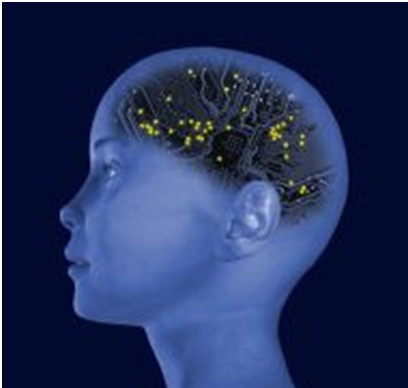
People consider learning music as an enjoyable form of hobby, but many are still unaware that musical training has really something more on their mental abilities. Neurologic studies show that there is a strong correlation between musical training and certain other mental intelligence. Read the following informations for the benefit of your child in school.
SOME SCIENTIFIC RESULTS OF LEARNING MUSIC IN IMPROVING CHILD’S INTELLIGENCE
MAKING THEM MATHEMATICALY ANALYTIC
It has been proved through well-established and accepted scientific research that Musical training has a positive impact on academic environment especially on Math subject, because there are 2 distinguished types of reasoning being improved in musical training: the SPATIAL TEMPORAL REASONING (STR) and LANGUAGE ANALYTICAL REASONING (LAR). LAR would be involved in solving equations and obtaining a quantitative result and STR would be is utilized in activities like chess when one needs to think ahead of several moves. Spatial intelligence is also an ability to perceive the world accurately and to form mental pictures of things. This kind of intelligence, by which one can visualize various elements that should go together, is critical to the sort of thinking necessary for everything from solving advanced mathematics problems.
Musical instrument class introduces children to basic physics, like one small example, plucking lesson teaches children about harmonic and sympathetic vibrations.
Music and math are highly intertwined. By understanding beat, rhythm, and scales, children are learning how to divide, create fractions, and recognize patterns. Learning music wires a child's brain to help him better understand other areas of math,
OTHER INTELLIGENCE BENEFITS OF MUSICAL TRAINING WHEN STARTED AT YOUNG AGE
1. Musical training forms bigger grey matter volume in the primary motor cortex of the brain and in the auditory cortex, which processes all kinds of sounds.
2. Improving the auditory and motor skillsof a child through Musical training, induces structural changes and modification in the primary auditory and primary motor areas of their brain. Children who had taken music lessons, showed larger brain responses on a number of sound recognition tests.
3. Music training enhanced levels of memory and attention when measured by tests that monitor electrical and magnetic impulses in the brain.
4. Musical training physically develops the part of the left side of the brain known to be involved with processing language, and can actually wire the brain’s circuits in specific ways.
5. Musical training helps in developing “neurophysiological distinction” between certain sounds that aid in literacy.
6. Music training expands the working memory capacity, and thus reduces the impairing effects on memory of working memory overload. Increasing working memory capacity also improves the ability to think, that manifest in IQ scores.
7. Musical training enhances activity of genes involved in dopamine secretion (the feel good hormone), and transport synaptic function, learning and memory.
